

Since publication in 2020 Adrian has produced the following addenda and errata:
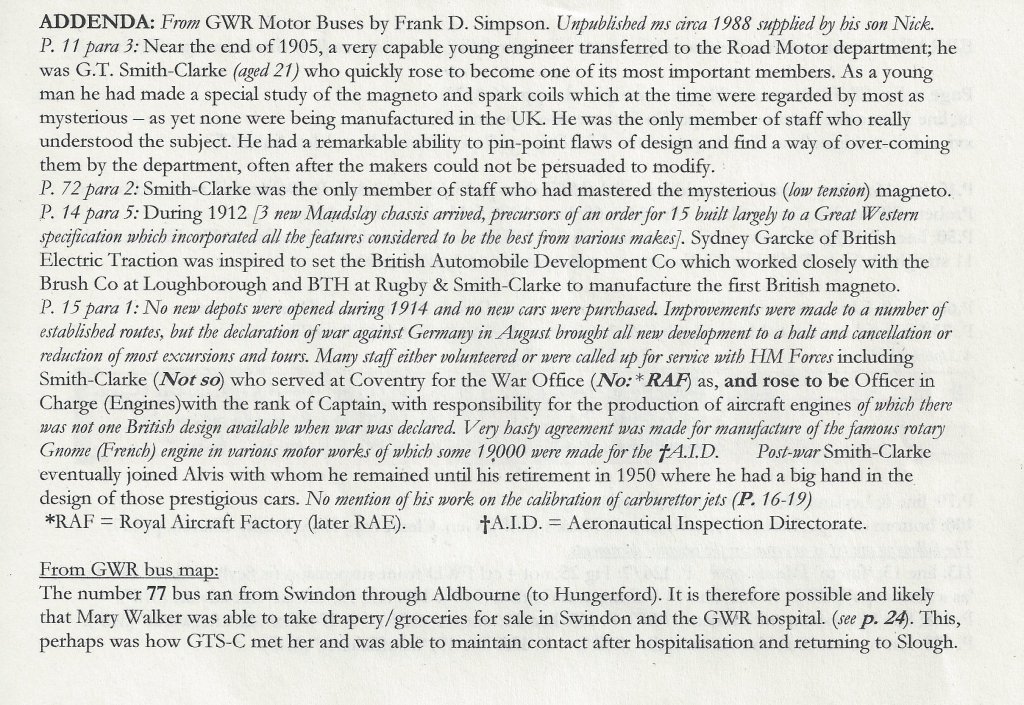
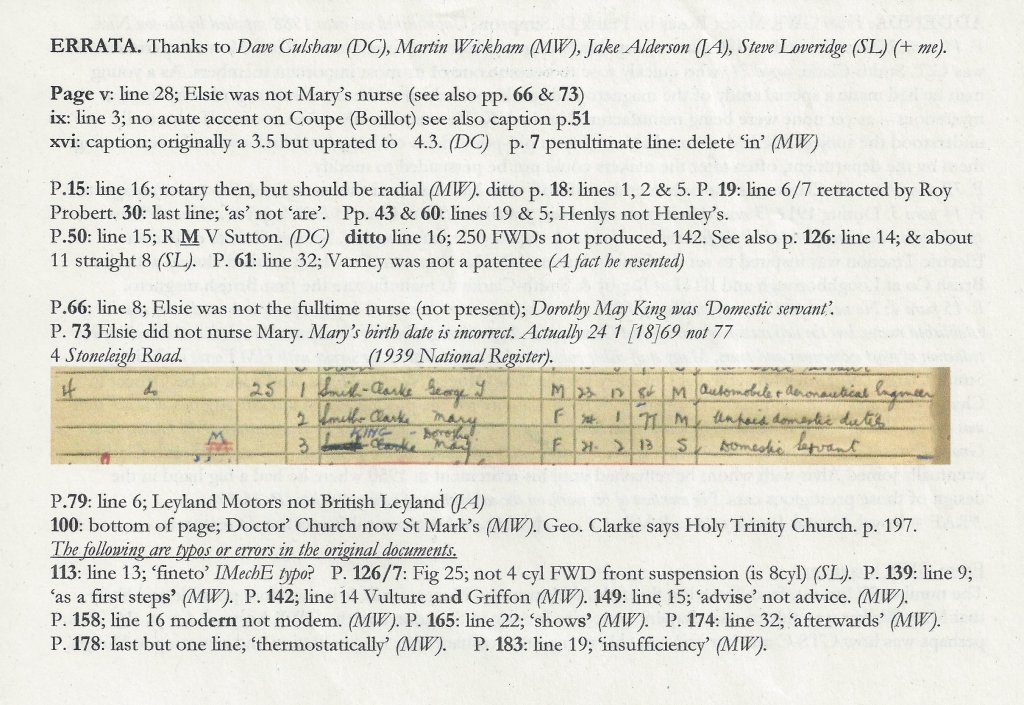
Copies of the book are available from the Trust on request. Stocks are held by both Martin Wickham and John Fox.
From B517, 2009 – Martin Boothman writes:
The George Thomas Smith-Clarke Birthplace Plaque

Nearly two years ago AOC member Doug Pound telephoned to tell me that Smith Clarke’s birthplace had been located in Bewdley, and that the Bewdley Civic Society was prepared to think about creating some kind of memorial. This seemed a great idea, so I contacted Greg Wrapson, the Alvis Register chairman, who agreed to join the AOC and the Civic Society in a project to put up a plaque on the house where Smith-Clarke was born. So the collective spirit was willing from the start, but collective intent and drive was also greatly needed over a long period to jump all the hurdles that were before us until the job could be done.
An unexpected and welcome link was the initial involvement in the project of Mark Joseland, nephew of C.P. Joseland, an early employee of Alvis, who inter alia drove in the 1921 200 Miles Race. Mark’s father owned an Offord 4.3 tourer until after the war.
Doug found that the present owner of the house, Walter Pullan, whose written permission we needed, was in an old people’s home. Fortunately he agreed and so, with many thanks to Walter, that was one important step taken. There followed a long sequence of approvals of the type of plaque, its design, planning and then manufacture until it was a ll finally done and the plaque could be erected at 6 Lower Park, Bewdley.
So on a sunny and warm day in early April some 50 people made up of Civic Society, AOC and Register members, and the Mayor of Bewdley, Barbara Stallwood, gathered outside the house and witnessed the unveiling of the plaque by Amanda Smith , Smith-Clarke’s great niece, supported by Adrian Padfield, AOC member, retired consultant anaesthetist and author of Smith-Clarke’s entry in the Oxford Dictionary of National Biography.

By blocking the access to several houses and being somewhat cavalier with the fortunately dry grass verge, we managed to fit in three Alvis cars, the middle one being Doug Pound’s TE 21.

Afternoon tea and sandwiches had been provided at the adjacent Quaker Meeting House where we gathered after the unveiling. Amanda Smith laid out lots of material relating to her great Uncle (whom she remembers well) which many of us studied with great interest. Adrian gave an excellent talk about Smith-Clarke, throwing a lot of light on his non Alvis activities, including his early involvement in amateur radio, hospital administration, iron lung developments at the height of the post war polio scare, and astronomy. Indeed the plaque records that Smith-Clarke’s contribution to astronomy, particularly at Jodrell Bank, brought him a Fellowship of the Royal Astronomical Society.
So at the end of the afternoon we all felt that we’d had a proper celebration for a remarkable engineer who had made major contributions outside his best known field of automobile engineering, and that his importance had been fully recognised in Bewdley as truly one of their famous sons.
I’ve mentioned before in the Calendar that Adrian Padfield had his submission about Smith-Clarke accepted by the Oxford Dictionary of National Biography. Do go out of your way to see this. Most people can look it up on line using their library cards, but those of you who can’t, may drop into their local reference library or archives and look him up the old fashioned way. It is well worth it.
As an addendum to this story, I believe members will be interested by the following information about other residents of Lower Park from just before Smith-Clarke’s time.
Nos. 6 and 7 Lower Park were originally one house, and in the 1860’s the home
of George and Hannah Macdonald . He was a Methodist Minister and they had
retired to Bewdley to be near their daughter Louisa who had married an ironfounder from Stourport, one Alfred Baldwin. They lived a few doors away at Lower Park House.
The Macdonalds had 11 children. Nothing too special about that in those days you may say, but one daughter, Alice, married John Kipling and had a son named Rudyard. Another, Georgiana, married Sir Edward Burne-Jones, the Pre-Raphaelite artist. Another, Agnes, married Sir Edward Poynter, a painter and designer who became President of the Royal Academy, and, as was mentioned above, Louisa married Alfred Baldwin. Their only son was named Stanley and he was born at Lower Park House.
Stanley went on to become Prime Minister three times between the two wars, and became the first Earl Baldwin of Bewdley. We know from biographies that Rudyard Kipling as a child used to regularly visit Bewdley to see his cousin Stan!
Many thanks to the Civic Society for providing these lovely notes on an astonishing family.
See also The Cape Engineering Company

