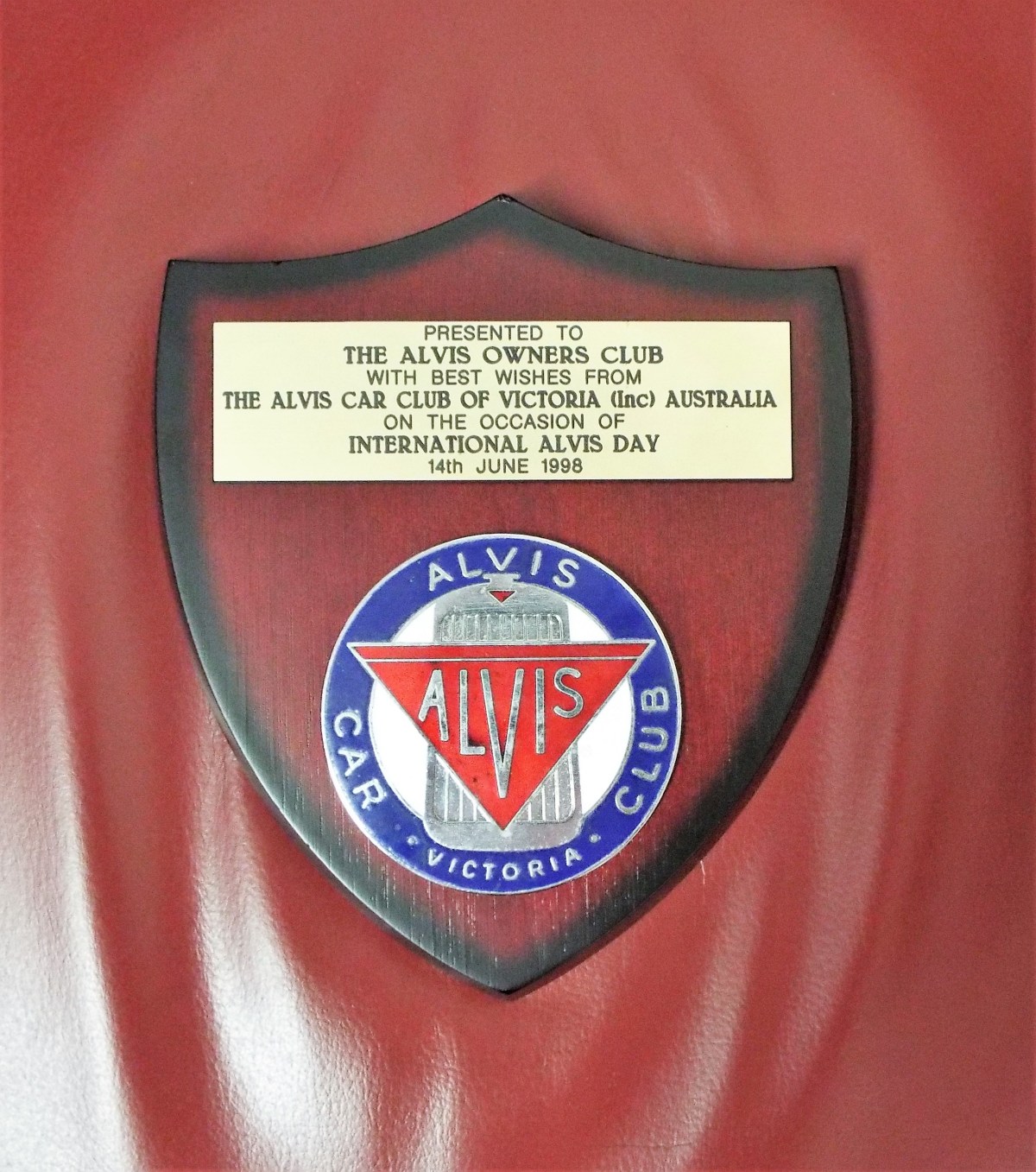
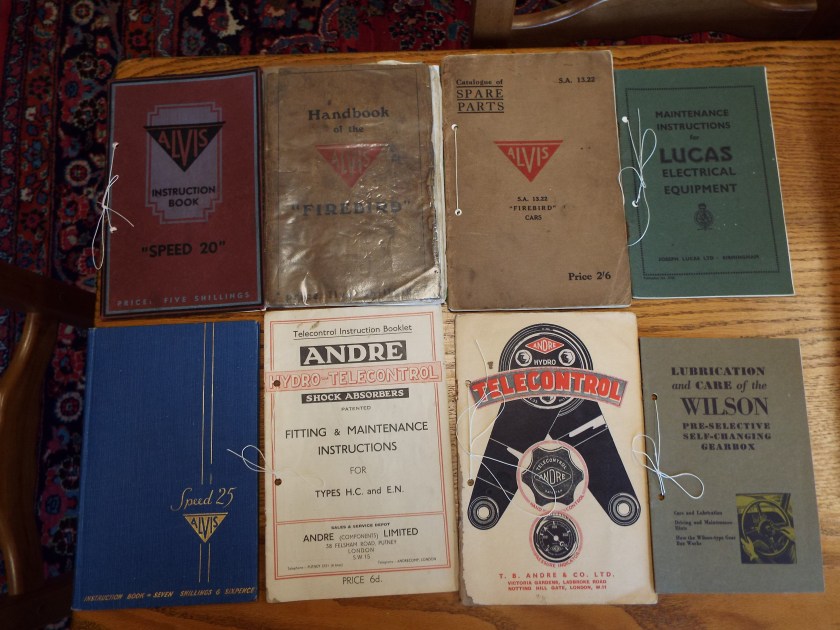
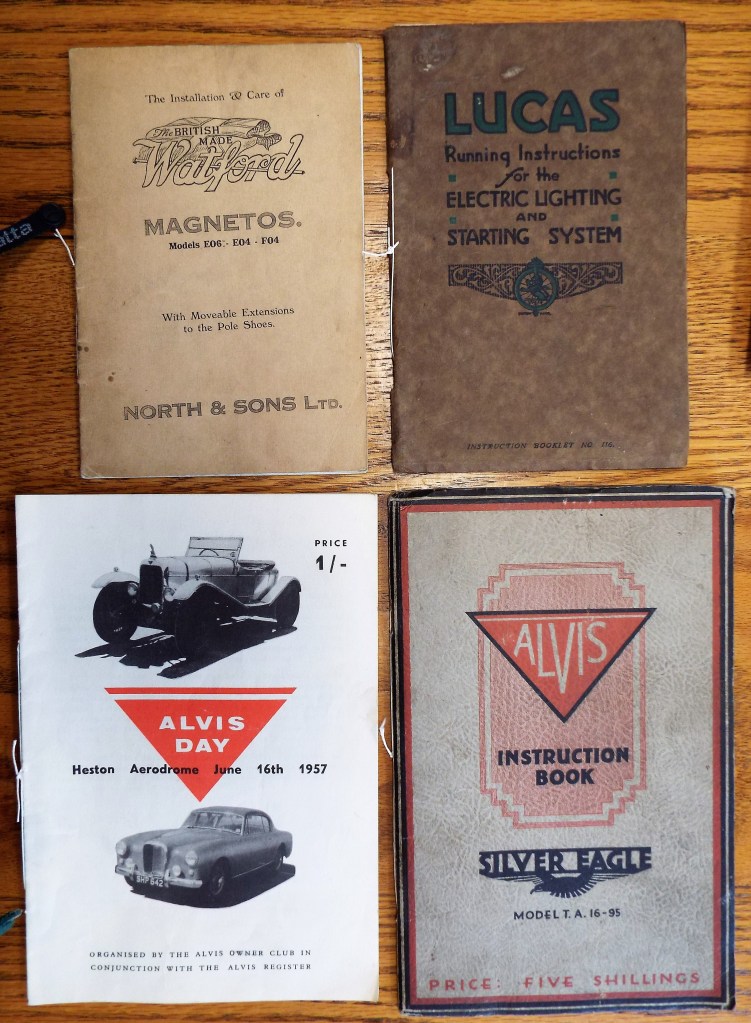
We have withdrawn our deposits with the Herbert in Coventry who have carefully conserved them for many years. So Christmas came early, opening eleven boxes of goodies, all wrapped in white paper and tied up in string, these are a few of our favourite things…..
The big boxes included Photo Albums 1-5 which we published in digital form six years ago. Now we can enjoy looking through the physical version. See Albums
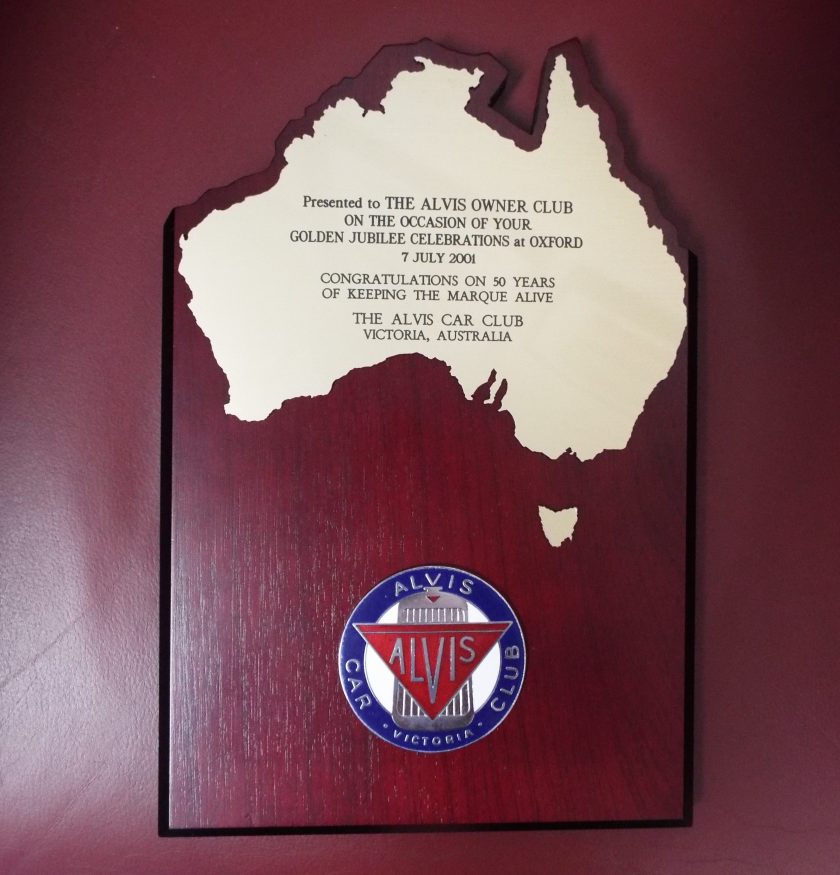
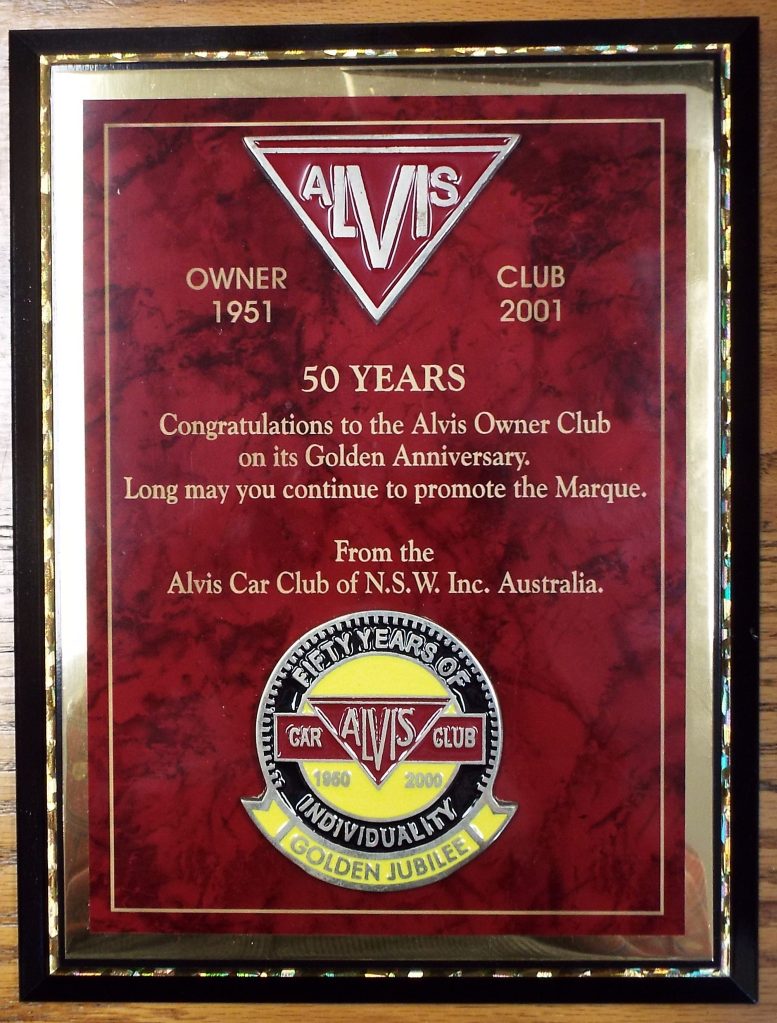
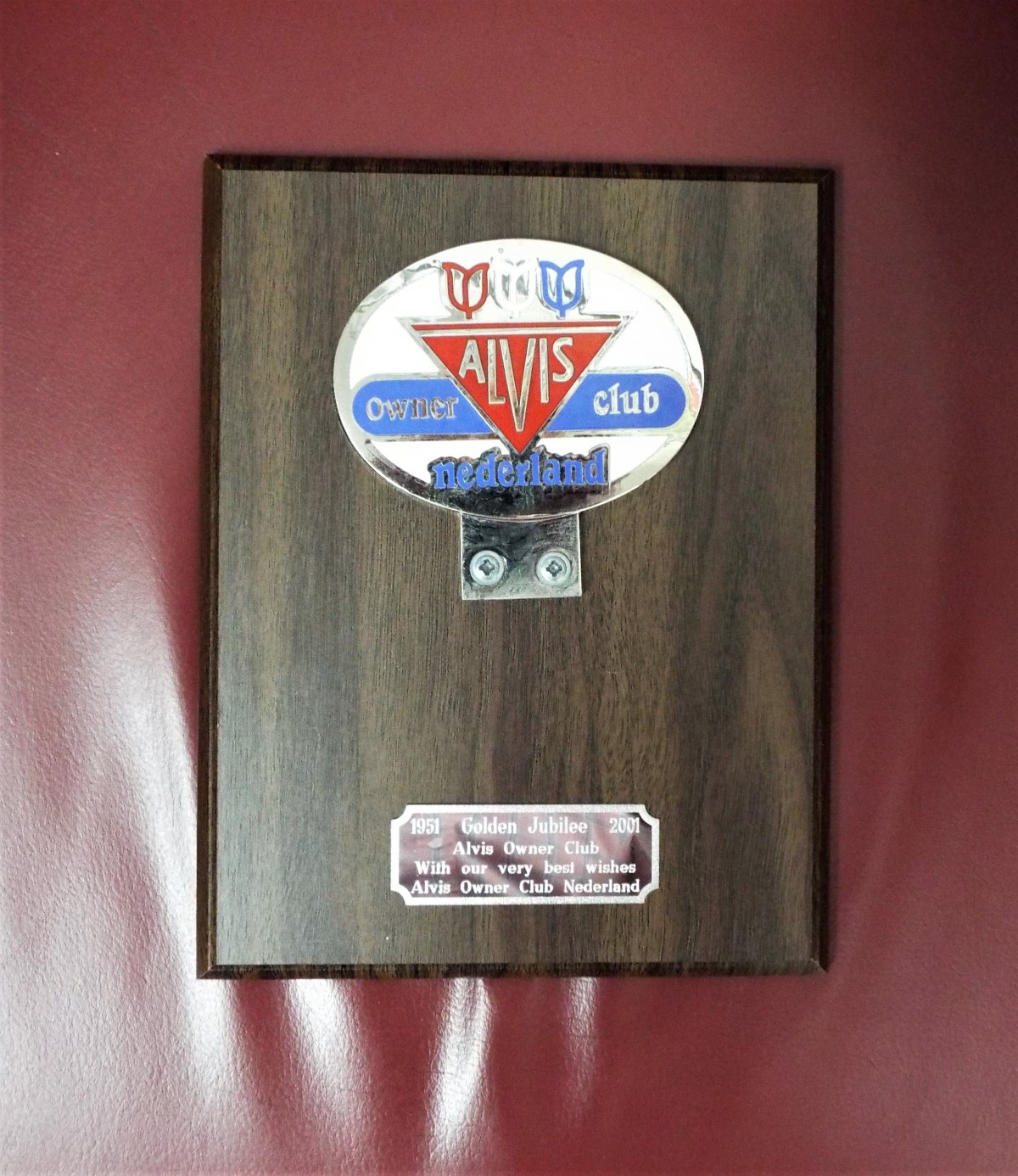
Hidden away for far too long were these items presented to the AOC in 2001, the Jubilee year.
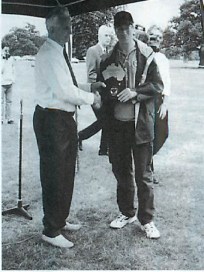
Chairman Arthur Fairburn receives the plaque from Richard Tonkin
Arthur receiving the ACC plaque from Richard Budd
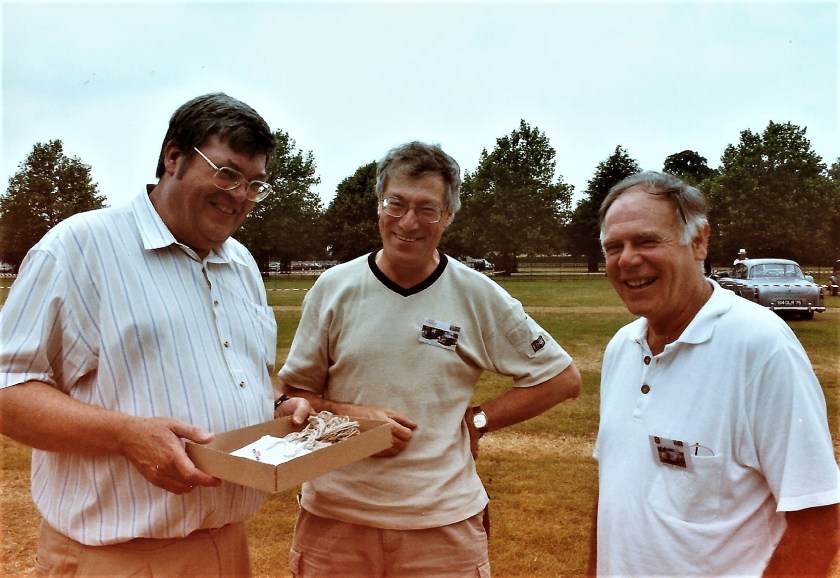
Ken Cameron with the Richards
….and from our Dutch friendsEven older, is this..
These will be on display at Bowcliffe in 2019, the start of the Centenary Year.
A section of Instruction and Parts booksA different Apprentice Badge
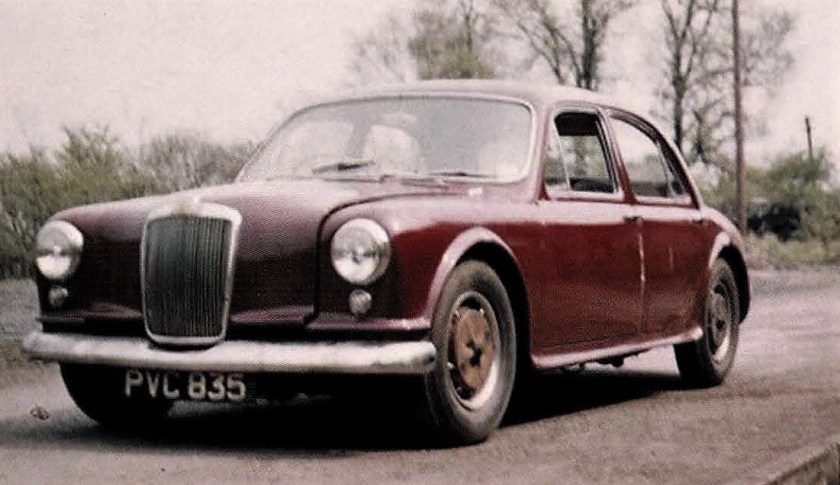
A new Follower this week had a familiar name and following several email exchanges has ended up with a fascinating story of survival of a rare Speed 20 model with the inevitable question, how many are left? To read the full story click BXL 835.
Coen van der Weiden asked about the survival rate of the 95 TE21 dropheads produced. The survival statistics published by Red Triangle, on display at the NEC last month, show 83% of all TEs surviving. This is based on the assumption that if a car has been spotted within the last twenty years, it probably still survives. Having recently collected the 352 TE records for the archives, and checked a sample of licence and mot records, there is a significant number of “can’t be sure” cars. There are cars not on DVLA records for a number of different reasons. If you know of a TE21 that has definitely been scrapped or is still around but not DVLA registered, please write to us, click alvisarchive@btinternet.com
Unfortunately the fascinating website howmanyleft does not include Alvis cars.
The long awaited release of the Alvis Car Club badge has arrived, click badge for details of how to purchase from the Alvis Owner Club.
The last post on Alvis Apprentices produced some positive feedback and in particular a comment from Mike Dunn.

One of our visitors on our Open Day last Friday was an Alvis apprentice in the 1960s who had worked in the service department. He brought with him his apprentice agreement, a dinner menu and a photograph which he kindly let us copy.
This post has now been transferred to a page, Apprentices
I was in contact with the organisers of the Hampton Court Concours of Elegance last Autumn and again this Spring, principally to arrange AOC participation in 2019 and 2020 as the celebratory 100 years of Alvis.
Being reminded that we could nominate a candidate for the Inter-Club Concours on Friday 31st August 2018, we took up the challenge and promised we would provide an entry by July. Some firm requests by the South East Section did not easily bring up a short-list, but George Butlin was persuaded that his 1938 Alvis Speed 25 Drophead – coupe by Charlesworth, substantially modified during its construction by Hoopers, definitely needed an airing and a good polish.
George was left to his frenetic preparations and to finalise the details of his entry ‘By invitation’, direct with the organising committee. Thankfully, he had prepared a most suitable resume of the car’s history with some fine references to the Hooper connection, its wartime exploits and political canvassing in the post-war years prior to George’s ownership and of course there is no-one better able to describe with passion the intricacies of the Speed 25 model and his own car in particular.
George Butlin being presented with the RAC Club Trophy by HRH Prince Michael of Kent behind his magnificent Alvis Speed 25 Charlesworth Drophead-coupe; a day to remember.
As an Alvis Owner Club nominated entry, George entered alongside a huge array of immaculate and very distinguished marques with equally important historical significance, so it says much for the quality of the restoration and his constant upkeep, that the panel of selected Royal Automobile Club judges decided that his Alvis Speed 25 should be the RAC Club Trophy winner.
This huge accolade will be followed by presentation of the car in the Rotunda at The RAC Club in Pall Mall during the coming weeks, where George and Annie will have further opportunities to represent the Alvis marque, and the Speed Models amongst other exhibits, and no doubt the 1929 Mercedes Benz S-Type , ex-Earl Howe, which won the distinguished Pegasus trophy in the 60 limited Private Entry class, which will be the highlights on show to the motoring press.
13645 4.3 Vanden Plas FMP 888 – Jeremy Coleclough’s concealed hood VDP 4.3 as private entry at Hampton Court Concours of Elegance 2018, being present for the whole 3-day event and competing for the coveted Pegasus Trophy amongst those invited to participate.
A rare Alvis never registered with the AOC had success at Pebble Beach this year.
3½ Litre SA 25.63 Vanden Plas 3449 Tourer – photo John Fasal via Dave Culshaw and Wayne Brooks
First delivered to the Maharajah of Mayurbhanj it has remained in India and a photo of its current state can be found at number 22 on Pebble Beach 2018
A date for your 2019 diary is Friday 14th June when the Bowcliffe British Car Concours takes place, featuring Alvis and Bentley.
This is the start of the AOC International Weekend based at York.
On 15th June the Trust will hold an Open Day at our Hycilla office. Invitations and booking forms will follow later in the year.
Grand Basel was not a Concours but featured the last Alvis made, click Graber TF21
Unipower MH 8875 bridge layer – photo Neil Millington
We are pretty good at answering car related questions, but even with the help of ex-Alvis employees we were not able to answer the following two questions – can you help?
From Keith Roberts:
Q. Having long been an enthusiast of Alvis military vehicles I was pleased to find your web page. My interest falls between automobiles and the armoured vehicles of Alvis, to be exact my interest relates to the Alvis-Unipower trucks. Do you have records related to the MH-660 or MH-8875 trucks produced in the 1990s and if not, can you suggest where such information may exist? Many thanks for any help you can give.
A. Martin Wickham says the design work was done by Unipower at their Greenford site and they were built in the Walsgrave factory. The vehicles went into service with the Royal Engineers, and their museum at Chatham may well be the place to seek further information. We will ask our Followers if they have any information on these vehicles.
Something over 50 years ago I read an article in “Autocar” I think. It was about the work of an emigre French aerodynamicist who came to Britain in WWII to escape the Nazis. He had a theory about using a specially designed exhaust system to boost the power and fuel efficiency of aero engines. The Government was sufficiently interested as to allot him an ALVIS LEONIDES engine to experiment with. He designed and kitted it out with tuned exhaust pipes – one for each cylinder – which looked very like those designed by Walter Kaaden for racing 2 stroke motorcycles. The article reported that he obtained a 10% or better increase in power output and an approximately equal improvement in fuel efficiency.
At the time of the work described and of the writing of the article, there were no electronic aids to perform the calculations needed, nor to test the results of these calculations. The calculations had to be performed with pencil and paper using slide-rule and log-tables, aided and abetted by blood, toil, tears and sweat and many gallons of midnight oil.
Eventually, satisfied that his calculations, he made up his prototype system. For the 9 cylinder engine it required nine separate exhaust pipes. Because this was difficult, time consuming and expensive, and because there was no means of performing mathematical modelling of the interplay between all the salient dimensions, the resulting pipes were all built like trombones; adjustable in all salient dimensions. For weeks, if not months, he carefully adjusted all the dimensions against each other and recorded the results until he came up with an optimised set of dimensions.
These produced: –
A useful (10% from memory?) increase in power output
A useful reduction in fuel consumption per unit of power produced (again about 10% from memory.) In other words one got an extra 65 BHP from the same fuel consumption as observed in the unmodified engine.
A stunning reduction in noise level. It was reported that with the motor running at full power one could easily hear the tappets working. This would have been immensely useful if used on an aircraft like the Westland Lysander employed for inserting and evacuating S.O.E. operatives into and out of occupied France.
What then happened bordered on farce. He reported his findings to the Ministry who sent assessors down to examine his system. It seems that, not being content simply to test his optimised set-up, they insisted on playing with the adjustability of the dimensions. The result was that they so stuffed the operation of the motor that it simply would not run! Our Frenchman then berated them in lurid French – “Vous foux, imbecilles Anglais” being among the more repeatable terms of abuse he used for their stupidity – and he stormed out “In a truly Gallic huff!” (The words in quotes are exactly as used in the article.)
What subsequently happened to the Frenchman and his work is unclear, except that the latter was never acted upon. That is until Walter Kaaden independently resurrected his work 20 years later for use on racing two-stroke motorcycles.
I think you will agree it is a fascinating story, and worth the while of the Alvis Archive to resurrect if you can find it. Please feel free to edit my account and add it to the archive as an un-documented recollection – even though I can personally vouch for the accuracy of the general thrust of the story as a retired research scientist.